


NISM X Taxmann's Equity Derivatives – Textbook on Indian Equity Derivatives Market—Futures | Options | Strategies | Clearing | Margining | Accounting | Tax—Worked out Against Live NSE & BSE Quotes
NISM X Taxmann's Equity Derivatives – Textbook on Indian Equity Derivatives Market—Futures | Options | Strategies | Clearing | Margining | Accounting | Tax—Worked out Against Live NSE & BSE Quotes
Couldn't load pickup availability
 Worldwide Delivery
 30 Days Easy Return
 Secure Payment
- Author: NISM (An Educational Initiative of SEBI) Format: Paperback


Product Description
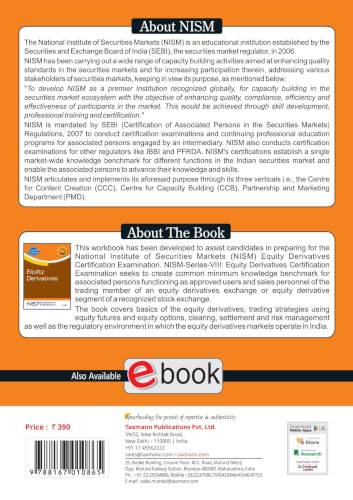
Equity Derivatives is a complete, self-contained textbook on the Indian equity derivatives market, written by the National Institute of Securities Markets (NISM) and published by Taxmann. The book covers the basics of equity derivatives, trading strategies using equity futures and equity options, clearing, settlement and risk management, and the regulatory environment in which the equity derivatives markets operate in India. Across ten chapters it builds from the ground up—what a derivative is and how these markets evolved, how a stock index is constructed and maintained, how futures and options contracts are specified, priced and settled, how a dozen distinct option strategies are assembled and what each pays off, how orders are matched and margins computed on an Indian exchange, and finally how the whole edifice is governed, accounted for, taxed and policed. Its distinguishing quality is method. Concepts are never left abstract. Contract specifications are dissected against live NSE and BSE quotes. The four index-weighting methodologies are computed side by side from a single data set, so the reader can see precisely how the choice of method changes the answer. Every hedge is run through both a rising and a falling market, demonstrating that the effective price is locked either way. Each option strategy arrives with a strike-and-premium table, a payoff computed at successive spot levels, an identified break-even, and a chart—and the strategies are taught as extensions of one another, a collar as an extension of the covered call, a butterfly as a short straddle with its tails capped. The book is candid about the limits of the page, too: it tells the reader that the best way to understand the trading mechanism is to watch a live screen, and that horizontal and diagonal spreads simply cannot be drawn as payoff diagrams. This March 2026 version is written against SEBI's recent overhaul of the equity derivatives framework, with footnoted circular references running to February 2026: the expiry-day rationalisation under which NSE has adopted Tuesday and BSE Thursday, the rise in minimum contract value to ?15 lakh, the delta-adjusted Future Equivalent Open Interest formulation, the tightened algorithmic trading rules, the phased Cyber Security & Cyber Resilience Framework, STT rates drawn from the Union Budget 2026-27, and a margin change that takes effect only on 5th May 2026. Because each regulatory statement is footnoted to its source circular number and date, the book doubles as a reference whose every position can be independently checked. This book is intended for the following audience: Anyone Who Wants a Rigorous, India-Specific Grounding in Equity Derivatives—the book assumes no prior exposure and builds from first principles Traders and Investors who use index and stock futures and options and want to understand payoffs, pricing, margins, trading costs and taxation properly rather than anecdotally Dealers, Terminal Operators, Authorised Persons and F&O Sales Staff at broking firms Operations, Clearing, Settlement, Risk, Surveillance and Compliance Professionals who need working command of SPAN margining, position limits, physical settlement and collateral rules Students and Job Aspirants in finance, commerce and management, including CA, CS, CMA, CFA and MBA (Finance) candidates Faculty, Trainers and Institutions looking for a reliable, well-sequenced teaching text on the subject Candidates for the NISM-Series-VIII Certification, for whom this is the prescribed workbook The Present Publication is the March 2026 Workbook Version, developed by NISM Certification Team with subject matter expert Dr. Aparna Bhat; reviewed by the Examination Committee comprising stock exchange representatives and industry experts. It is published exclusively by Taxmann, with the following noteworthy features: [Authoritative Authorship] Written by the institution that sets the standard—content created and reviewed by NISM, SEBI's capacity-building arm, rather than a third-party interpretation of it [Worked Numbers, Not Definitions] Index computations, futures and option payoffs, margin calculations, break-even points and cost build-ups are all carried out on the page [Every Payoff Mapped] Payoff tables and charts for futures and for every option strategy that admits a diagram, each with maximum profit, maximum loss and break-even stated explicitly [Formulae Stated and then Applied] Cost of carry in simple, discrete and continuously compounded forms; the Black-Scholes call and put equations with every variable defined; portfolio beta; and the theoretical settlement price [Live Market Data as Teaching Material] A Nifty futures quote from 3rd October 2025 and Nifty call and put option quotes are taken apart field by field [Both Sides of Every Trade] Options are analysed from the buyer's and the writer's perspective; hedges are tested against both favourable and adverse price moves [Footnoted to Source] Regulatory statements carry the SEBI circular reference number and date, making the book verifiable and updatable rather than merely assertive [Self-testing Built In] Each chapter opens with Learning Objectives and closes with sample questions in MCQ and True/False form, with answers indicated. [Practice Over Theory] Order types, trader workstation layout, corporate action adjustments, trading cost arithmetic and grievance procedures get the same careful treatment as pricing models [A Lasting Desk Reference] The margin stack, position limits, accounting entries per ICAI guidance notes and AS-11, and the taxation of F&O income keep the book useful long after a first reading The coverage of the book is as follows: Chapter 1 — Basics of Derivatives o What a derivative is and the range of underlying assets; the evolution of these markets from twelfth-century trade fairs through CBOT (1848, 1865), CBOE's listed options (1973) and the first stock index futures (1982); the Indian story via the L.C. Gupta and J.R. Varma Committees and the launches from June 2000 onward; forwards, futures, options and swaps compared; hedgers, traders and arbitrageurs and why each needs the others; exchange-traded versus OTC markets; and the counterparty, price, liquidity, legal and operational risks participants carry Chapter 2 — Understanding the Index o What an index is and why it matters; market-capitalisation weighted, free-float, price-weighted and equal-weighted methodologies, each computed in full—including the rebalancing an equal-weight manager must perform; what makes an index good; liquidity and impact cost worked through an order book; index construction, maintenance and revision, including the diversification-versus-liquidity trade-off and the diminishing returns from adding constituents; major Indian indices; and applications—index funds and tracking error, index derivatives and ETFs Chapter 3 — Introduction to Forwards and Futures o Forwards and why their customisation becomes a limitation; futures contract specifications read off a live quote—lot size, contract cycle, expiration, tick size, settlement prices, trading hours; the rise in minimum contract value to ?15 lakh, with lot sizes set for a ?15–20 lakh range; the expiry-day rationalisation framework and what NSE's Tuesday and BSE's Thursday mean in practice; BSE Sensex futures specifications compared, and the pairs-trading opportunities divergent expiries create; terminology from basis and cost of carry through open interest to naked and calendar spread positions; payoff charts; futures pricing under both the Cost of Carry (no-arbitrage) model—developed from the synthetic-futures argument, with no-arbitrage bounds, assumptions and convenience yield—and the Expectations model, and the contango and backwardation conditions that follow; why cash and futures prices converge on expiry; and the uses of futures, including beta-adjusted portfolio hedging and the three forms of arbitrage Chapter 4 — Introduction to Options o Why options exist at all, given futures; calls and puts, buyers and writers, and the asymmetry between right and obligation; option terminology built from real quotes; contract specifications including the weekly, monthly, quarterly and long-term half-yearly expiry cycles; moneyness, intrinsic value and time value, and options as wasting assets; payoff charts for all four basic positions; futures versus options; the five determinants of an option's value, the direction of each effect, and why time decay structurally favours the seller; the Greeks—Delta, Gamma, Theta, Vega and Rho; the Binomial and Black-Scholes models with full formulae; implied volatility set against historical volatility; and a closing analysis from both the buyer's and the seller's side Chapter 5 — Strategies Using Equity Futures and Equity Options o Long and short hedges using stock futures, each tested in both directions; beta-adjusted portfolio hedging; naked and calendar spread trading positions; cash-and-carry and reverse cash-and-carry arbitrage. Then the options: the four vertical spreads, followed by long and short straddles and strangles, the covered call, collar, butterfly spread and protective put—everyone with its own strike-and-premium table, spot-by-spot payoff, break-even and chart, and each presented as a modification of the one before. Horizontal and diagonal spreads are explained conceptually, with the reason payoff diagrams cannot be drawn for them. Closes with put-call parity arbitrage, delta-hedging, the FutEq OI formulation worked through four client portfolios, and the put-call ratio read as a contrarian indicator alongside the four price-versus-open-interest signals Chapter 6 — Trading Mechanism o How an Indian F&O exchange actually works: trading entities and the corporate hierarchy from Corporate Manager down to Dealer; market timings; order types and conditions, with a worked stop-loss showing the difference between trigger and limit price; price-time priority matching; operating ranges and SEBI's tightened dynamic price band criteria; how stocks and indices qualify for derivatives trading and the Product Success Framework that keeps them there; adjustments for corporate actions and the value-neutrality principle behind them; trading costs—STT, GST, stamp duty, IPFT and turnover fees, plus bid-ask spread and impact cost, with a full cost build-up for a single trade; algorithmic trading, including Algo IDs, kill switches, the orders-per-second threshold and the white box versus black box distinction; how to read published F&O data; and the Investor Risk Reduction Access platform with the technical-glitch and inter-exchange business continuity arrangements behind it Chapter 7 — Introduction to Clearing and Settlement System o Clearing members and how open positions and obligations are computed; interoperability of clearing corporations and the collateral inefficiency it removed; settlement of futures and options, including physical delivery of stock F&O and cash settlement of index contracts; margining under SPAN—initial margin at 99% VaR, premium and assignment margins, intraday crystallised losses, staggered delivery margins, peak and beginning-of-day parameters, cross margining, early pay-in, the margin pledge mechanism that replaced power-of-attorney arrangements, and client-level collateral segregation; position limits at client, member and market-wide level; violations and penalties; running account settlement; the Core Settlement Guarantee Fund and Investor Protection Fund; SEBI's six measures strengthening the index derivatives framework; and the Cyber Security & Cyber Resilience Framework with its five resiliency goals Chapter 8 — Legal and Regulatory Environment o The Securities Contracts (Regulation) Act 1956—the statutory definitions of securities and derivatives, and the Section 18A conditions under which a derivatives contract is legal and valid at all; the SEBI Act 1992 and SEBI's objects and powers; the regulations governing trading, clearing, settlement and risk management; the net worth, liquid net worth and certification requirements for membership of the derivatives segment; and the Standard Operating Procedures for a member default and for a stock exchange outage Chapter 9 — Accounting and Taxation o Forward contracts under AS-11, treated differently for hedging and for speculation; accounting for equity index and stock futures in the client's books per ICAI guidance notes—at inception, on daily settlement, at the balance sheet date, on squaring-up and on default—with dated worked balances; accounting for index and stock options, cash-settled and delivery-settled. Then taxation: F&O income under Profits and Gains from Business or Profession, the Finance Act 2005 amendment that removed speculative treatment for exchange-traded derivatives, set-off and eight-year carry-forward, capital gains treatment for FPIs, presumptive taxation, audit thresholds, and STT rates and collection mechanics. Chapter 10 — Sales Practices and Investors Protection Services o Risk as the probability of missing an expected return rather than merely losing capital, and the parameters a client's risk profile actually depends on; the Risk Disclosure Document and why it exists; written anti-money-laundering procedures under the PMLA 2002—customer due diligence, client acceptance policy, the risk-based approach, Clients of Special Categories and Politically Exposed Persons, KYC and in-person verification, the Unique Client Code, and suspicious transaction reporting to the Financial Intelligence Unit – India; and the grievance redressal machinery—how and where to complain, SCORES, and the SMARTODR/Online Dispute Resolution portal with its grievance categories, conciliation-and-arbitration stages and statutory timelines. Closes with general Do's and Don'ts for investors Every chapter is built on the same internal skeleton, so a reader who learns to navigate one can navigate all ten. Learning Objective — Each chapter opens with a boxed Learning Objectives panel, setting out precisely what the chapter commits to covering. Once the chapter has been read, the same panel serves as a revision checklist Continuity Before New Material —A short bridging passage joins what has just been learned to what follows. The sequencing is disciplined throughout: beta is defined before beta-adjusted hedging appears, the Greeks before delta-hedging, open interest before the FutEq OI formulation Worked Examples — Every illustration follows the same sequence: the setup and its assumptions, a table laying out the position, the outcome split into labelled branches—Case I: Stock rises to Rs. 1,580 on expiry day, Case II: Stock falls to Rs. 1,480—and a closing line drawing out what the arithmetic was meant to show. Positions with several possible outcomes extend to a third and fourth branch. Tables and payoff charts carry no numbering and appear inline at the point of argument, so there is no figure apparatus to flip back and forth between Sourcing Held in the Footnotes — Regulatory authority sits at the foot of the page rather than in the prose. Footnotes run continuously from 1 to 13 across the entire book instead of restarting with each chapter, and carry SEBI circular reference numbers and dates or source URLs—leaving the main text uncluttered while keeping every regulatory statement traceable Test — Each chapter ends with a boxed Sample questions panel: numbered items in (a)–(d) or True/False form, with the correct option in bold. They are framed as caselets and computations rather than recall prompts, so the closing panel puts the chapter's arithmetic to work rather than just its vocabulary Read more
Customers also viewed
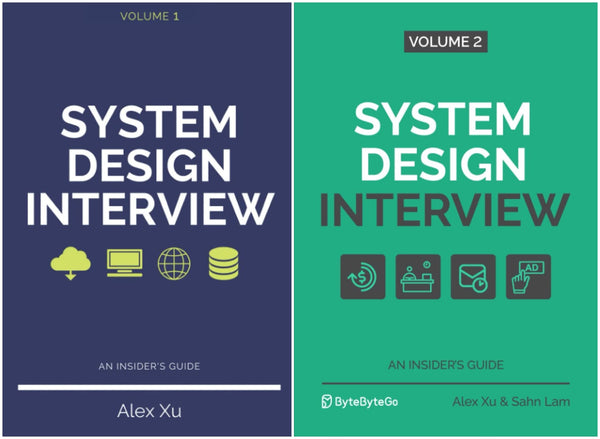
System Design Interview: An Insider’s Guide – 2 Volume Set by Alex Xu

Atomic Habits: An Easy & Proven Way to Build Good Habits & Break Bad Ones

Death: An Inside Story

The Laws of the Spirit World

Cims India Medical Reference Book for B.Pharm/M.Pharm Students and Medical Representatives

Bratva Bride (Bratva Series)

Ncert Biology Text Book for Class 11 and 12 (Set of 2 Books)

Pathoma

??? ??????????? ??????????: ??-?? ?? ???? ??? (Sant Tiruvalluvar Tirukkural: Jan-Jan Ki Bhasha Mein)

Zero to One by Peter Thiel with Blake Masters | Bestselling Book on Startups, Entrepreneurship, Innovation & Business Strategy | English Paperback

?? ??????? ?? ?????????? | Dhan Sampatti Ka Manovigyan | The Psychology Of Money (Hindi) Paperback – 25 June 2021

You are the Best Friend: A True story of falling in Love & finding inner Peace | An inspiring story by the author of You are the Best Wife

???? ????? (Nizhal Vetta//Psychological Survival Thriller//Hippy Malayali)

Xam idea Physics Class 12 – (CBSE 2026-27) | Mind Maps | Solved NCERT | Solved PYQs | MCQs, A-R, Case-based, VSA, SA, LA Questions | Solved 2026 CBSE Examination & Sample Papers

You Got This: Art of Loving Yourself | Emotional wellness | Mental health | Happiness | Self-Care | Personal growth | Mindfulness | Motivational | Positive Thinking | National Bestseller

Youth Competition Pharmacist Exam Guide 2026-27, Hindi & English Medium, 84 Sets, 7680 Objective Questions with Answer Key, RRB AIIMS-CRE ESIC NHM

Wuthering Heights by Emily Brontë: Penguin Classics | Iconic Victorian Gothic Romance | Now a Major Motion Picture Starring Margot Robbie and Jacob Elordi
![Yayati By V. S. Khandekar [paperback] V. S. Khandekar [Jan 01, 2015]](http://universalreads.com/cdn/shop/files/41uO8ncgzEL_600x600.jpg?v=1789380007)
Yayati By V. S. Khandekar [paperback] V. S. Khandekar [Jan 01, 2015]

You Were Never Meant To Read This: Return to the World of Can We Be Strangers Again
Collections
View all-

Bestselling Books Collection
Explore our top-selling books loved by readers worldwide. This collection features the...
-

Most Ordered
Explore the Most Ordered books at UniversalReads. Featuring top-rated titles across fiction,...
-

Children's Books
Discover the best Children’s Books at UniversalReads. From bedtime stories to early...
-

Arts & Photography
Discover inspiring Arts & Photography books at UniversalReads. From painting guides to...