


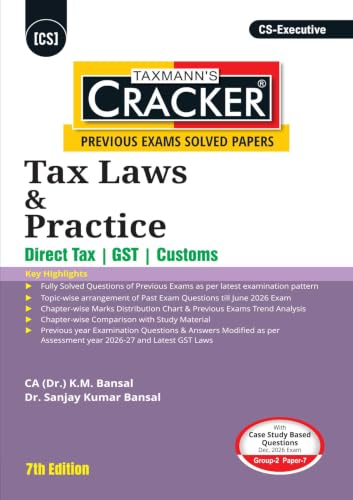
Taxmann's CRACKER COMBO for CS Executive | Dec. 2026/June 2027 Exams | Group 2 – Papers 5 to 7 | CRACKER Series | CMSL, ECIPL | EC & IPL and Tax | June 2026 Edition | Set of 3 Books
Taxmann's CRACKER COMBO for CS Executive | Dec. 2026/June 2027 Exams | Group 2 – Papers 5 to 7 | CRACKER Series | CMSL, ECIPL | EC & IPL and Tax | June 2026 Edition | Set of 3 Books
Couldn't load pickup availability
 Worldwide Delivery
 30 Days Easy Return
 Secure Payment
- Author: CS N.S. Zad , CA (Dr.) K.M. Bansal , Dr. Sanjay Kumar Bansal


Product Description
CRACKER COMBO for CS Executive – Group 1 | Papers 5 to 7 assembles, in one coordinated set, the three CRACKER titles that together span the entire Group 2 of the CS-Executive programme—Paper 5 (Capital Market & Securities Laws), Paper 6 (Economic, Commercial & Intellectual Property Laws) and Paper 7 (Tax Laws & Practice). The unifying idea behind every CRACKER is that you learn the paper not by re-reading the law in the abstract, but by working through the exact questions the Institute of Company Secretaries of India (ICSI) has actually asked—each book is built entirely from previous examination questions, regrouped topic-by-topic within each chapter, and solved in full to the latest examination pattern, including the application-driven, case-study questions that now carry a defined, high-mark weight in the current pattern. Crucially, answers are not reproduced as originally printed; every solution is recomputed to the present legal position—for the tax paper, to AY 2026-27 and the current GST/Customs regime; for Paper 5, to the latest provisions including the 2023–2025 regulatory changes; and for Paper 6, to the latest applicable provisions and amendments (including the recent foreign-trade and overseas-investment frameworks). The entire set is applicable for the December 2026 and June 2027 examinations. The Present Publication is the June 2026 Edition, authored by CS N.S. Zad, CA. (Dr) K.M. Bansal & Dr Sanjay Kumar Bansal, with the following noteworthy features: [The CRACKER Method—Why It Works] It's not the volume of questions, but how each one is worked for the candidate: o Model-answer Form—solutions follow ICSI's idiom (provision ? crisp points ? conclusion), so you learn the structure examiners reward, not just the law o Cited to Authority—exact section/rule/regulation and SEBI circular by number and date, backed by SAT/court precedent and SEBI orders—how application questions must be answered o Built to the Current Pattern—the case component is front-and-centre: a 20-mark block in Paper 5, a substantial chapter in Paper 6, the highest-weightage objective format in Paper 7 o Data-driven Revision—a marks-distribution chart plus a Practical-vs-Descriptive trend table show exactly where to spend time o Topic-wise, Not Year-wise—every question grouped by concept, tagged by sitting and marks, repeats flagged—a topic's full exam history at a glance [Fully Solved Past-exam Questions, Mapped to the Latest Pattern] Worked in full, showing the expected depth, structure and statutory referencing of a model answer [Topic-wise Arrangement (up to June 2026)] Questions regrouped under subject headings within each chapter for concept-wise understanding [Original Exam Tagging] Each question carries its sitting(s) and marks; repeated questions flagged with every appearance [Answers Referenced To Source] Exact section/rule/regulation, and SEBI circular by number and date where relevant [Grounded in Decided Matters] Tribunal and judicial precedent plus SEBI guidance/orders underpin the application answers [Worked Practical & Numerical Problems] Step-by-step computations (NAV and returns with portfolio-valuation tables, capital-market instruments and derivatives in Paper 5; salary/house-property formats, IGST/CGST/SGST set-off ledgers, value of supply and customs/baggage duty in Paper 7) [Comparison and Rate Tables] 'Distinguish between' topics laid out point by point; rate tables and prescribed formats double as revision notes [Chapter-wise Marks-Distribution Chart] o Paper 5: 2021–June 2026 o Paper 6: June 2021–June 2026 o Paper 7: Dec 2023–June 2026 (six-exam averages) [Previous-exam Trend Analysis] Granular classification of each question by chapter, marks and category (Practical vs Descriptive/Theory) [Comparison with the ICSI Study Material] Chapter-by-chapter mapping so the CRACKER pairs with the Institute's content without gaps [Updated with the Latest Law] AY 2026-27 with the section 115BAC default regime, special rates effective 23rd July 2024 (STCG u/s 111A; LTCG u/s 112A at 12.5% without indexation, ?1.25 lakh threshold), revised surcharge and section 87A rebate, and current GST/Customs provisions (Paper 7); latest securities, economic, commercial and IP-law amendments (Papers 5 & 6) [Dedicated Case-study/Case-based Component] o Paper 5: Six fully solved multi-part case studies o Paper 6: A substantial narrative case-study chapter o Paper 7: Case-based objective questions across Section A (Income Tax) and Section B (Indirect Taxes) [Solved June 2026 Paper with Suggested Answers] A Complete, current-pattern, full-length mock at the end of each book [Point-wise, Provision-anchored Answers] Easy to learn and to reproduce under time pressure Each Volume in the CRACKER COMBO follows a Systematic, Student-friendly Design Paper 5 — Capital Market & Securities Laws (Two Integrated Parts) o Part I — Capital Market (Ch 1–7): Basics of the capital market (financial-system structure; AIFs, private equity, HNIs, pension funds, FCCBs/FCEBs); secondary market (stock exchanges, book closure/record date, instrument and derivatives practice); SCRA, 1956; SEBI—objectives, duties and functions; Depositories & Depository Participants (Depositories Act 1996; demat); securities-market intermediaries (merchant bankers, custodians, investment advisers, research analysts, FPIs); IFSCA o Part II — Securities Laws (Ch 8–18): ICDR (book-building, IPOs, lock-in, exit for dissenting shareholders, fast-track/preferential/bonus issues); share-based employee benefits & sweat equity (with Companies Act 2013); issue & listing of non-convertible securities; LODR (committees, RPTs, continuing obligations, circular-based questions); takeovers; insider trading; FUTP; delisting; buy-back; mutual funds (SEBI MF Regulations; NAV and returns); collective investment schemes o Ch 19 — Case Study Based Questions and the Solved June 2026 Paper (Parts I & II) Paper 6 — Economic, Commercial & Intellectual Property Laws (400+ Solved Questions Spanning Roughly Two Decades of Papers up to June 2026) o Part I — Economic & Commercial Laws (Ch 1–12): Foreign-exchange dealings; inbound FDI; outbound investment & overseas borrowing (ODI/ECB); foreign trade; SEZs; foreign contribution; PMLA & economic offences (incl. fugitive economic offenders); prohibition of benami transactions; competition; consumer protection; legal metrology & essential commodities; RERA o Part II — Intellectual Property Laws (Ch 13–18): Foundations of IP; patents; trademarks; copyright; geographical indications; designs o Ch 19 — Case Study Based Questions and the Solved June 2026 Paper Paper 7 — Tax Laws & Practice (Direct Tax | GST | Customs) (Three-part Body, Recomputed to AY 2026-27) o Part I — Direct Tax (Ch 1–13): Direct tax at a glance; basic concepts; exempt incomes; the five heads (salary, house property, PGBP, capital gains, other sources); clubbing and set-off/carry-forward of losses; deductions; computation of total income & tax liability of various entities; tax incidence on companies; procedural compliance o Part II — Indirect Tax: GST & Customs (Ch 14–20): Indirect taxes at a glance; basics of GST; levy & collection; time, value & place of supply; input tax credit & computation of GST liability; procedural compliance under GST; overview of the Customs Act o Part III — Case-Based Objective Questions: Section A (Income Tax) and Section B (Indirect Taxes), featuring extended, multi-part case sets that mirror the high-mark integrated questions o Solved June 2026 Paper across descriptive, practical and case-based segments. (The pool is predominantly CS-Executive, with select CS-Professional questions concentrated in the GST chapters and a few CMA questions for added coverage) The three books are deliberately built on the same skeleton, so learning to navigate one teaches you all three. Macro-structure (Per Book) o Plan-before-you-practise—the marks-distribution chart, the trend analysis and the ICSI Study-Material comparison, so you prioritise before you begin o Solved chapters in ICSI sequence—arranged into the paper's natural parts (Capital Market/Securities Laws; Economic & Commercial/IP Laws; Direct Tax/Indirect Tax) o A dedicated case-study/case-based segment—the application block, fully solved o The Solved June 2026 Paper (suggested answers)—a full-length, current mock under updated law Micro-structure (Within Each Chapter) o Topic banners that track the statute's own scheme o Topic-wise grouping of past questions, each tagged with sitting and marks (repeats flagged across appearances) o Fully worked answers setting out governing provisions, regulation/section numbers and circular references, with distinguishing tables and step-by-step reasoning o Theory and problems side by side, with dedicated problem-and-solution groupings where the subject is quantitative, and (in Paper 5's listing chapter) a separate set of circular-based questions. (Paper 7 additionally paginates each chapter independently for quick reference) How to Use the Combo? Start with the Front Matter of Each Book — Read the marks chart and trend table first to rank chapters by yield, and use the Study-Material map to align with whatever you've already studied Practise Topic-by-topic, Not Paper-by-paper-from-the-top — Within a chapter, work the grouped questions to see how one concept has been examined repeatedly Write the Model Answer — In the point-wise, provision-first format the solutions demonstrate; for numerical, follow the prescribed computation formats exactly Drill the Application Blocks — Give disproportionate time to the case-study/case-based segments, since that is where the marks are increasingly concentrated Finish on the June 2026 Solved Papers — Attempt each as a timed, full-length mock under current law before the exam Read more
Customers also viewed
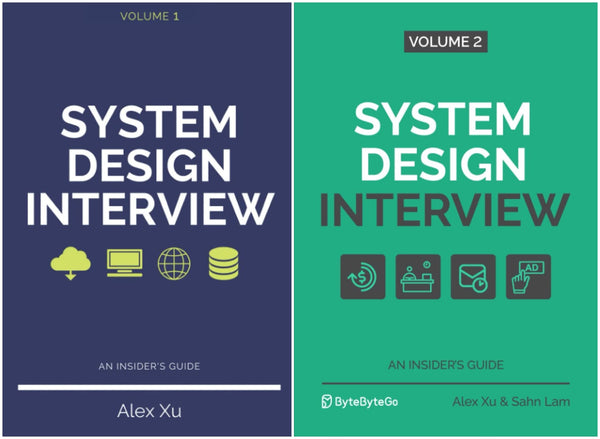
System Design Interview: An Insider’s Guide – 2 Volume Set by Alex Xu

The Mirror of Infinite Endings: The highly anticipated return to the No. 1 Sunday Times bestselling Once Upon a Broken Heart series and the epic love story of Jacks and Evangeline

Psychology (7th Edition) | Pearson | NEP 2020 Aligned | By Saundra K. Ciccarelli, J. Noland White & Girishwar Misra

Threshing Day (Limited Deluxe Edition): Return to the Empyrean world with thirteen stories starring your favourite Fourth Wing characters.

The 100 Year Blueprint: An Indian Doctor's Guide to Longevity

Maa Amma Anadha | ?? ???? ???? | Telugu Novel by GANA

Mahaprastanam - (Telugu)

Jujutsu Kaisen Manga Box Set 2 Vol. 22-30 - Complete Collection Series 8 Books Collection Set (Jujutsu Kaisen books box set Vol 22-30) By Gege Akutami

Jujutsu Kaisen Manga Box Set (Vol. 0-30) - Complete Collection Series 31 Books Collection Set (Jujutsu Kaisen books box set Vol 0-30) By Gege Akutami

Ayodhya Cherina Krishna - Telugu Novel

Atomic Habits: An Easy & Proven Way to Build Good Habits & Break Bad Ones

Death: An Inside Story

The Laws of the Spirit World

Cims India Medical Reference Book for B.Pharm/M.Pharm Students and Medical Representatives

Bratva Bride (Bratva Series)

Ncert Biology Text Book for Class 11 and 12 (Set of 2 Books)

Pathoma

My First 100 Animals Stickers

My First 100 Animals And Birds | Ages 0–5 Years | Early Learning | Padded Board Book For Kids | Wild Animals | Farm Animals | Pets | Vocabulary Building | Toddlers & Preschoolers | Latest Edition
Collections
View all-

Bestselling Books Collection
Explore our top-selling books loved by readers worldwide. This collection features the...
-
Most Ordered
Explore the Most Ordered books at UniversalReads. Featuring top-rated titles across fiction,...
-

Children's Books
Discover the best Children’s Books at UniversalReads. From bedtime stories to early...
-

Arts & Photography
Discover inspiring Arts & Photography books at UniversalReads. From painting guides to...